


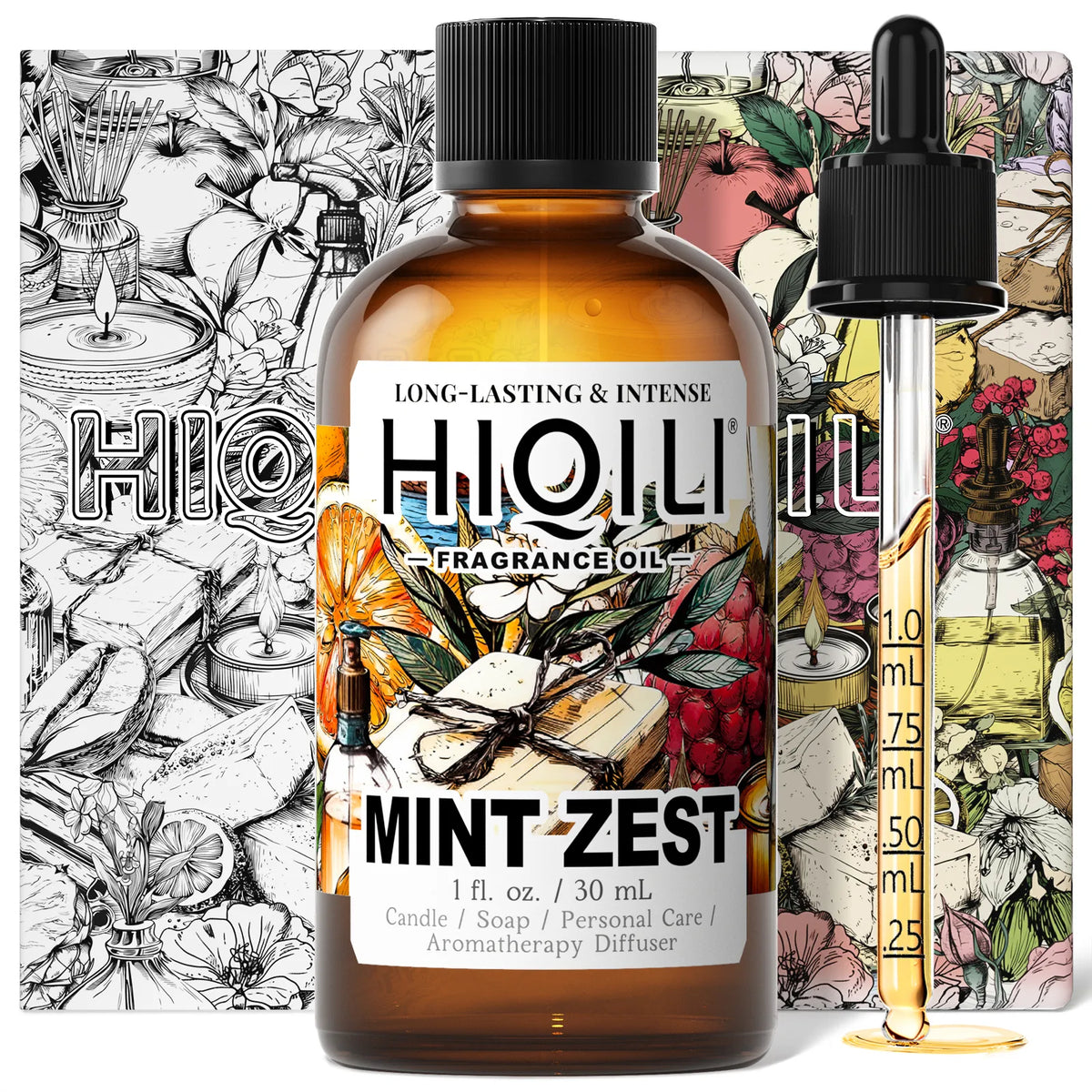

Mint Zest Fragrance Oil for Diffusers & Soap Making
A cool aromatic citrus — mint and grapefruit open into green leaf and lily of the valley, settling on musk and cedarwood.
Description
Mint Zest Fragrance Oil for Diffusers & Soap Making Fragrance Oil is a aromatic citrus accord. Mint, Grapefruit lift the opening, green leaf, rose, lily of the valley carry the heart, and musk, cedarwood hold the base. It is a blended fragrance oil for candles, wax melts, cold process soap, reed diffusers, linen sprays and perfume work, and the accord behaves the same way in each.
Mint fragrance oils usually come in two flavors: candy-cane sweet, or toothpaste-sharp. Mint Zest takes neither. Grapefruit and green leaf round the mint out, and rose and lily of the valley soften the finish, so you get a clean, cool scent with enough softness to wear on skin. It is a mint for people who do not want to smell like gum.
Mint Zest Fragrance Oil for Diffusers & Soap Making Fragrance Oil Overview
Product Details
What Does Mint Zest Fragrance Oil for Diffusers & Soap Making Fragrance Oil Smell Like?
Mint Zest opens on the cool, bright edge of mint and grapefruit together, and the first impression is a clean one, not a sweet one. Green leaf keeps the opening crisp, then rose and lily of the valley take the sharp corners off. Musk and cedarwood close it, and that is what keeps the mint from fading to nothing: the base gives the cool top something dry and woody to sit on. The result is fresh and uplifting, and it stays clean rather than turning sugary.
How the Scent Moves
The first ten minutes are the coolest, and the mint is at its most forward here. Grapefruit keeps it bright rather than cold. From ten minutes to an hour and a half the rose and lily of the valley soften the accord and the scent turns airy, then the musk and cedarwood come up underneath to hold it steady. In a candle the cool lift survives the hot throw better than a straight peppermint would, because the woody base carries it. In soap, the citrus top can fade through cure, so judge a bar after four to six weeks.
Why Makers Choose Mint Zest Fragrance Oil for Diffusers & Soap Making
- A Mint Without the Candy: Grapefruit, green leaf, rose and lily of the valley round it out, so it reads clean and cool instead of candy-cane sweet or toothpaste-sharp.
- The Woody Base Carries the Cool: Musk and cedarwood underneath are why the fresh lift survives a hot throw instead of vanishing after the first burn.
- Citrus That Works in Soap: A 205°F flash point and a 2% to 5% load make it a usable cool scent in cold process, where straight citrus can fade.
- One Accord, Several Formats: The same clean, cool lift carries from diffuser to candle to soap, keeping a product line coherent.
How to Use It
- Candle & Wax Melts: Start at 6% to 10% by weight of wax. Add at 180°F to 185°F, stir for two full minutes, and pour at the temperature your wax maker recommends. Cure soy for one to two weeks before the first burn.
- Cold Process Soap: Start at 2% to 5%. Add after trace at the coolest temperature your recipe tolerates. Fragrances can accelerate trace, so line the mold first and stir by hand once the oil is in.
- Reed Diffusers: Dilute into a diffuser base to the strength you want. The base notes keep the room from going flat once the top notes burn off, which is the usual failure point.
- Linen & Room Sprays: Solubilize before diluting, or the oil will ring the glass and leave a film on fabric. Test on an offcut before spraying anything you intend to keep.
- Body Care & Perfume: Use 0.5% to 2% in lotions and other leave-on products, and 1% to 10% in perfume or fine fragrance. Patch test anything that stays on skin before you sell it.
These are starting ranges, not ceilings. The maximum for this scent in each application is set by its IFRA certificate, and that document is what to check before locking a formula.
Safety & Documentation
- Flash Point 205°F (96°C), closed cup — high enough for gel wax and stable at normal candle-making temperatures. Keep it away from open flame.
- Concentrate, not a finished product — do not swallow, do not apply neat to skin, keep it out of eyes. Rinse with plenty of water if contact happens.
- Keep out of reach of children and pets — cats and dogs are more sensitive to concentrated fragrance than people are. Wipe spills with an absorbent cloth instead of rinsing them away.
- IFRA certificate and safety data sheet — available on request before you order, and supplied with bulk quantities. No animal testing.
Mint Zest Fragrance Oil for Diffusers & Soap Making
If you have any questions, you are always welcome to contact us. We'll get back to you as soon as possible, within 24 hours on weekdays.
-
Shipping Information
✓ Customs duties & import taxes included
Our standard shipping includes customs duties, import taxes and related fees for all supported countries. Express carriers (DHL / UPS / FedEx) are not included — those fees are paid by the recipient.📦 Order processing
Orders are dispatched within 1–3 business days.🇺🇸 United States delivery
7–14 calendar days after dispatch, shipped from our China warehouse.
A small number of items are stocked in our US warehouse — when your item shows US warehouse availability, delivery is 2–5 calendar days.🌍 All other countries
12–18 calendar days after dispatch.📍 Where we ship from
Most orders ship from our warehouse in South China. A limited number of SKUs ship from our US warehouse.🔎 Tracking
A tracking number is emailed to you as soon as your order is dispatched.Countries we ship to
United States, Canada, Mexico, United Kingdom, Ireland, Germany, France, Italy, Spain, Netherlands, Belgium, Greece, Australia, Singapore, Japan, Malaysia, United Arab Emirates.Note: delivery times may vary slightly during peak seasons (holidays, promotions, customs processing). Delivery estimates are in calendar days; processing time is in business days.
-
Customer Support
📧 Email: support@hiqili.com
🕐 Response time: within 24 hours on business days (Mon–Fri, 10am–4pm)Whether you have a question about your order, need product advice, or want help choosing the right scent for your project — just reach out. We love hearing from our community.
-
FAQ’s
Q: Where do you ship from?
Most orders ship from our warehouse in South China. A small number of items are stocked in our US warehouse for faster US delivery. A tracking number is emailed to you once your order is dispatched.Q: How long does shipping take?
Delivery time depends on your destination, counted from the day your order is dispatched:🇺🇸 United States: 7–14 calendar days (2–5 days if shipped from our US warehouse)
🇨🇦 Canada: 12–18 calendar days
🇬🇧 United Kingdom: 12–18 calendar days
🇦🇺 Australia: 12–18 calendar days
🇩🇪 Germany / 🇫🇷 France / 🇪🇸 Spain / 🇮🇹 Italy: 12–18 calendar days
🌍 Other supported countries: 12–18 calendar daysQ: How long before my order is dispatched?
Orders are dispatched within 1–3 business days.Q: Will I have to pay customs or import fees?
No — our standard shipping includes customs duties and import taxes for all supported countries. If you choose DHL, UPS or FedEx express, those fees are not included and are paid by the recipient.Q: What if my order is delayed?
Delivery times can vary slightly during peak seasons (holidays, promotions) or due to customs processing. If your order is taking longer than expected, email us at support@hiqili.com and we'll look into it. -
Contact Us
Have a question or need help? We'd love to hear from you!
📧 Email: support@hiqili.com
⏱ Response time: within 24 hours on business days (Mon–Fri, 10am–4pm)For order-related inquiries, please include your order number in your message so we can assist you as quickly as possible.